
Bartlett City Directory Holdings
Bartlett's strongest city directory collection is held across local and regional libraries. Schaumburg Township District Library documents historic telephone and criss-cross books. Bartlett Public Library supplies cataloged local works and licensed genealogy resources. Newspaper and museum collections fill years and names that the phone books miss.
| Collection | Years or scope | Where held | Access |
|---|---|---|---|
| Bartlett/Roselle phone books | 1948-49 | Schaumburg Township District Library | Ask local-history staff |
| Bartlett/Roselle/Bloomingdale books | 1953, 1956-59 | Schaumburg Township District Library | Physical local-history holdings |
| Wider regional directories | Chicago 1936, 1944, 1953; suburban runs through 1964-65; 1982/83 CD-ROM | Schaumburg Township District Library | Staff-mediated collection |
| Centennial and Talon yearbooks | Centennial 1891-1991; high school 1998-2001 | Bartlett Public Library catalog | Catalog and library access |
| Advisor newspaper | Cataloged from 1965; consulted issue June 19, 1968 | Illinois Newspaper Project; state library microfilm | Catalog lead and microfilm |
Coverage has gaps. A missing year or name is not proof that a person left Bartlett. The line could be unlisted, the household could be filed under another exchange, or the needed volume may sit in a different regional collection.
Bartlett City Directories by Exchange
The 1959 Illinois Bell book joins Bartlett with Bloomingdale, Hanover Park, Keeneyville, Medinah, Ontarioville, Roselle, Schaumburg Center, and Streamwood. It carries residential and yellow-page sections. Bartlett and Roselle numbers used TW 4 and LA 9 prefixes before all-numeric calling became standard.
That exchange clue is useful when an old number looks malformed. Search the prefix exactly as printed, then check both household and business sections. Regional grouping also explains why the same Bartlett family may appear under Roselle in one source and Bartlett in another.
Note: A telephone exchange describes a service network and era, not an incorporated boundary.
Read a Bartlett Directory Entry
A Bartlett city directory entry may be much simpler than the classic large-city listing. Phone books commonly give a surname, initials or given name, street address, and telephone number. Business pages may add a trade name or category. A reverse section, where present, reorganizes entries by address or number.
| Name | The subscriber or business label as printed, including initials. |
|---|---|
| Address | The period street and community label, which may differ from today's map. |
| Telephone | The exchange and line number used in that edition. |
| Section | Residential, business, classified, or reverse arrangement. |
| Citation | Volume title, year, page, and library or archive holding it. |
- Criss-cross directory
- A volume arranged by street address or phone number for reverse searching.
- Householder index
- A name or address list keyed to the person designated as the household entry.
- Abbreviation key
- The publisher's list explaining shortened names, streets, occupations, and symbols.
- Directory year
- The edition date, which may trail the date when information was gathered.
Photograph or transcribe the title page and abbreviation key with the entry. Those pages prevent a later guess about what a symbol or place label meant.
Bartlett Library Directory Tools
The Bartlett Public Library eResources list Ancestry Library Edition and FamilySearch for in-library use, plus HeritageQuest and Record Information Services. Its newspaper options include a Bartlett Examiner archive for 2011-2025, Chicago newspaper sources, and Daily Herald coverage. Access can depend on a library card or a visit, so do not assume every database works from home.
The catalog also lists Bartlett Centennial booklets and Bartlett High School's Talon yearbooks. A yearbook can confirm school-era names, clubs, teams, and photographs, but it should not be turned into a current address list. Ask reference staff to identify the edition, location, and any use limits before copying a page.
Bartlett is served through two library districts. Gail Borden's Main Library in Elgin and Rakow Branch are also relevant for some parts of the village. County and library boundaries do not always match a Bartlett postal address.
Regional Bartlett Directory Shelf
The Schaumburg local-history service offers a local-history librarian, the Illinois Collection, newspapers, atlases, digital archives, and links to historical groups. This is the best documented route to the old Bartlett-area phone-book runs. Contact staff with a target surname, year range, address, and any known exchange.
In-person help matters because a catalog title may cover several communities without listing each one in a short record. Staff can also point to nearby editions before and after the target year. That makes it easier to tell whether a name truly disappears or merely shifts between regional labels.
Trace Bartlett Families by Directory
City directories fill the years between federal census schedules and can show when a subscriber or business first appears at an address. Their omissions are just as important to check. Use a sequence, not one isolated hit.
- Set a target year and list every known spelling of the surname and street.
- Search the closest Bartlett-area phone book, including business and reverse sections.
- Record the volume, page, entry type, exchange, and exact address wording.
- Move to the edition before and after it, noting changes without guessing why they occurred.
- Compare the result with a census-era record, deed, newspaper, yearbook, cemetery, or museum item.
If a listing ends, test several explanations. The family may have moved, changed the account name, used an unlisted number, or fallen into a missing volume. An obituary or cemetery record can help close a life-history trail, while a deed answers ownership rather than occupancy.
Bartlett Directory Names in Print
The Illinois Newspaper Project identifies the Advisor of Bartlett and points to microfilm at the Abraham Lincoln Presidential Library. A participant record also identifies the Examiner of Hanover Park/Bartlett. Newspapers can add obituaries, club notes, business ads, school news, legal notices, and changes of address.
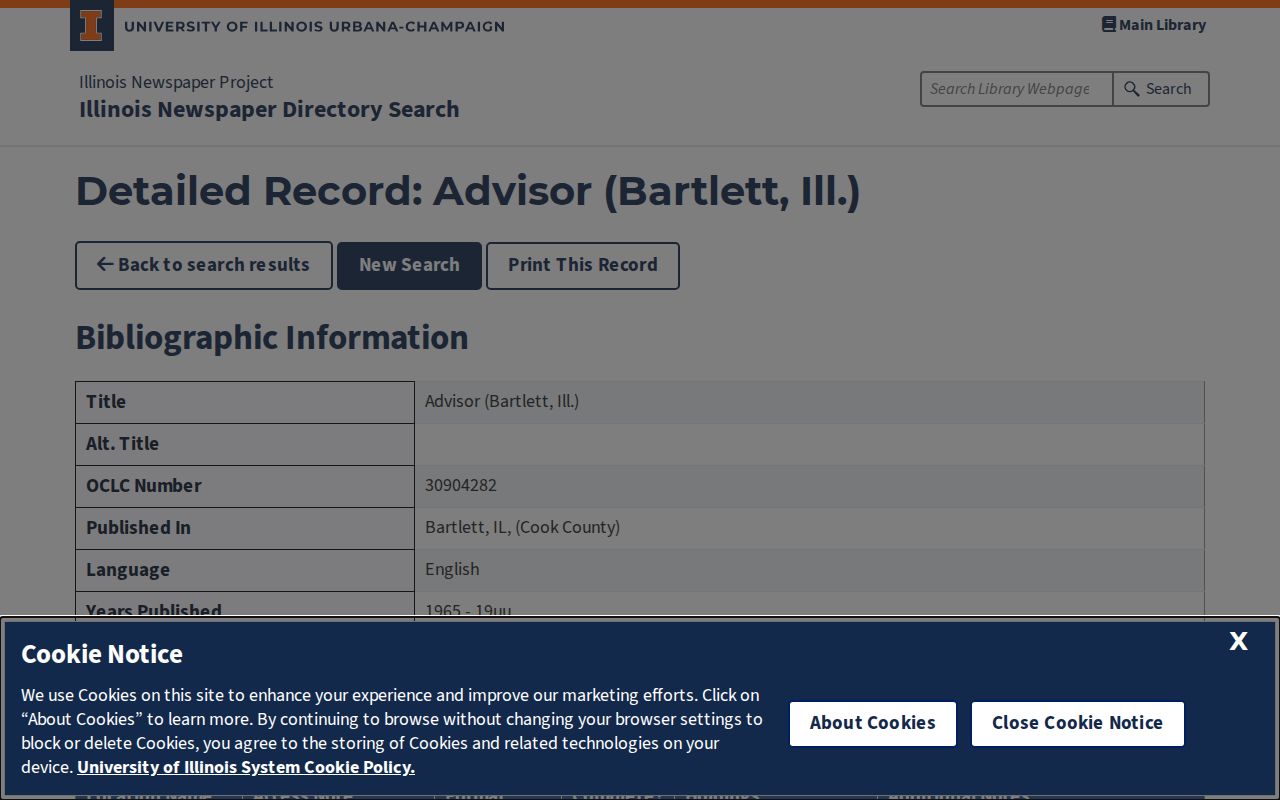
The captured catalog record supplies a title, place, date span, and holding lead. It does not claim that every issue survives or is searchable by name, so a librarian or microfilm visit may still be needed.
Search the exact directory name first, then the address, exchange, business, spouse, or organization. Newspaper evidence is strongest when the date sits near the directory edition.
Bartlett Museum Name Trails
The Bartlett museum online collection uses PastPerfect and shows images with age, size, use, and a short local connection. It is partial, and items are added over time. The History Museum at Village Hall and the original 1873 Depot Museum also support staff-mediated research.
One catalog example is an 1897 Howe pumper with a 27½-inch brass nozzle and links to local businesspeople and officials. An artifact can lead to meeting minutes, purchase records, newspaper reports, business listings, and named civic roles. It cannot prove that each person lived at a certain address.
For historical geography, the depot is crucial. Records may use Spaulding, railroad, Roselle, Elgin, or another period label. The failed 1959 Spaulding incorporation attempt and later annexation into Bartlett and Elgin explain why a name trail can cross present boundaries.
Bartlett's Early Telephone Clue
Village history reports a population of 408 and 200 telephones in 1910. That is a striking reason to search phone records for early Bartlett names. It is not evidence that half the residents had a unique household line. Businesses, shared service, unlisted subscribers, and the way the statistic was counted all limit the comparison.
Telephone franchises began in 1901, according to the civic timeline. Use that date as a starting point for municipal minutes, newspapers, and regional telephone material. Later directory holdings become much more specific by the late 1940s and 1950s.
Verify Bartlett City Directory Finds
A city directory should answer who or what was listed, where, and when. It should not be made to prove more. Compare a residential listing with a deed or census-era record; compare a business ad with a license, incorporation, or newspaper notice; compare a death clue with an eligible vital or cemetery source.
Use original records first when possible. Official library or museum interpretation with a cited item comes next, followed by a contemporary newspaper or directory entry. A modern summary works as orientation only. For present-day property research, the Bartlett street directory workflow routes an address to the correct county system.
Keep the date attached. A historical Bartlett listing never proves that the same person or family lives there now.